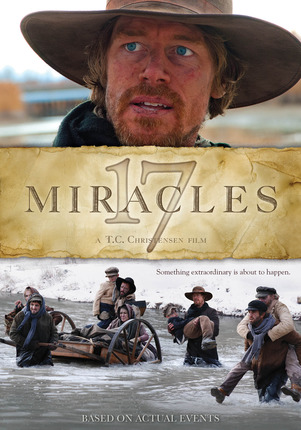
We finally watched 17 Miracles last week. I had not seen it before, though I certainly had heard some of the stories told in the film.
I enjoyed the movie as it reinforced for me the faith and devotion of the saints of the Willie handcart company. But I was troubled by it, too.
The movie’s protagonist is Levi Savage, a widower who became a sub-captain in the handcart company en route home from a 3-year mission to Siam. Levi is portrayed as faithful and strong, just the kind of man you’d like leading your company. He is also the one who recommended that the saint not leave for the west because of the lateness of the season.
His public opposition, portrayed as being sought by Captain Willie, was then repudiated by Willie, as well.
I don’t take issue with Savage’s opposition to leaving, nor with Willie’s encouragement to go. I presume each man operated out of his conviction. But the film does not give me that foundation. By the time this incident occurs in the film, we like Savage. We’ve seen his service in the Mormon Battalion, his loss of his wife, his mission call to Siam and his reluctant acceptance of the role as sub-captain. We like him. We trust him. We want him to lead us on a handcart trek.
We don’t know Willie at all. We only know he’s called Savage and Savage accepted. And we hear him denounce Savage publicly. We see nothing of Willie’s spiritual commitment, only his slavish obedience to his orders to deliver the company.
Later in the film, Savage is publicly reprimanded in another meeting by a visiting authority. Savage instantly recants his opposition and submits, once again, to the authority at hand. (And just in case we miss it, an end note among the credits reminds us again how wonderful it is that Levi Savage submitted after this public calling out.) As a viewer of the film (and knowing the outcome of the story), it’s very easy for me to side with Savage and assume Willie and the visiting authority are wrong and, even worse, uninspired. We watch members of the company suffer and die; those who do not die bear significant physical and emotional burdens. Yes, miracles occur, but at what cost?
I suspect life was more complicated, and I wish I had seen more of it in the film. I suspect Willie’s conviction was real, and I would have liked to have seen more of his own spiritual struggle.
I have never faced physical trials like those of the handcart companies, thank Heavens! But I have faced trials and the ambivalence that accompanies them. I have found myself having to choose between seemingly impossible alternatives. I have sought divine guidance and sometimes received it quickly and other times not. I have been questioned by doubters.
Life is complicated. And I applaud the film for showing some of the complexity that Levi Savage had to live with. But I would have preferred to see Willie’s complexity, as well.
I do not quibble about the miracles (though I could not count them). I acknowledge that miracles occur (though my teenage son watching with me did not; he kept looking for coincidences). And they still occur in my life and in the life of those I love (even if they do not see them).
I also know that most church leaders I know, especially those at the retail level in wards and branches, devote a great effort to seeking and understanding the Lord’s will. They may get it wrong sometimes, but they are trying to do the best they can with what they have. My role is to follow them as best I can, and, more importantly, to love them as best I can – that is, to love them with that Christlike love that is charity, a love that motivates me to see the best in them and to do what I can to lighten their load, to share their vision and to follow their lead.
Brief essays on my experience as a member of the Church of Jesus Christ of Latter-day Saints
Showing posts with label Doubt. Show all posts
Tuesday, January 29, 2013
Monday, January 17, 2011
"I don't believe in God."
We were not surprised to hear him say it, but hoped it wouldn’t be so soon. When our son delivered this message, my wife listened calmly and said little. In a follow-up conversation he allowed as how he’s not done thinking about it, yet, and he hasn’t made any final decisions. He is, after all, only 14.
But his best school friend is, like him, a bright scientific thinker, heavily influenced by the popular science minds today. And the friend is also somewhat confused by his family’s church’s teachings about some things.
As we’ve had follow up conversations, here are some things we’ve said:
The good news is that he’s come to this crossroads while he’s still at home with people who love him. And he’s willing to leave the book open for a while. And he’s still talking about how he feels. And his friendships at church are still very important to him.
But his best school friend is, like him, a bright scientific thinker, heavily influenced by the popular science minds today. And the friend is also somewhat confused by his family’s church’s teachings about some things.
As we’ve had follow up conversations, here are some things we’ve said:
1. No one can make you believe. In the end, you have to choose for yourself, and live with your choices.
2. At 14, you might not know everything you will learn in your life; there may be still more understanding to come that will influence what you believe.
3. Just as there are a lot of smart people you admire who do not believe, there are also a lot of smart people who do. Think about why people who believe do, and see if there’s anything in there for you.
4. Don’t give up on the wrong God. Just because your protestant friend’s view of the scriptures is hard for you to understand, listen to what your church teaches, and ask God for help. He can answer your prayers.
The good news is that he’s come to this crossroads while he’s still at home with people who love him. And he’s willing to leave the book open for a while. And he’s still talking about how he feels. And his friendships at church are still very important to him.
Thursday, January 7, 2010
On Testimony
I've written before about testimony – what we know and how we know it. Of course when we say we know, it is often not in the empirical sense, but in the sense of knowing as any jury might know something – based on the credibility of witnesses. There is a key difference in testimony, however. The scriptures repeatedly report that the Spirit can bear witness (as the Holy Ghost did at Jesus' baptism, for instance).
Modern revelation is even clearer on the subject as Joseph Smith and others testified of seeing heavenly messengers and witnessing miraculous events. Of course the witnessing of miraculous events is not limited to Latter-day Saints. Faithful people throughout the ages have attributed outcomes to God's merciful intervention in their lives.
A commenter raised a question the other day about that verse in Alma 32 which suggests that desire is the first step to faith, and that faith is an early step on the path to knowledge. Alma suggests desiring to know will lead us to put something to the test, to exercise faith, and that over time we will come to know. We teach of children this works with keeping the commandments, and realizing the blessings of the Lord. (Of course the Savior also taught this principle when he said "If any man will do his will he will know of the doctrine whether it be of God or whether I speak of myself" (John 7:17).) If we faithfully keep the commandments, we will sooner or later sense the blessing of those commandments in our lives. This has certainly been my experience.
James 1:5-6 suggests if we pray in faith, "nothing wavering", then we will receive assurance from the Lord. Some have cynically suggested that such "praying in faith" simply predisposes us to assume any presumed response is an answer to our prayer. While I can understand that argument, it's not my personal experience. And that is primarily because for me, answers to my questions in prayers rarely have come at the time I've prayed. Instead, the answer may come days or months or even years later, often triggered by independent circumstances.
A case in point: in my early college years, I had, like many students who really start studying church history, some specific questions that I hadn't been able to resolve in my mind. I had no issue with the Book of Mormon or even with the First Vision. I was confident that priesthood was restored through Joseph, but I wondered about later choices he made, presumably under inspiration.
I followed some advice I had received at the time to cling to what I knew (or believed) and to wait patiently for answers to these other questions. For some time I fervently prayed for resolution and none came, but I did continue to have that sweet confirmation of the spirit that the basic teachings of the church (and of Joseph) were true.
Years later (like 15 years later) I was teaching Church History and the Doctrine and Covenants in Sunday School. And in preparation for a particular lesson, I read passages in the Doctrine and Covenants that I had read many times before (by then I had taught Gospel Doctrine repeatedly, and even had taught Church History one year in seminary). All at once, as I read several particular passages, I felt my concerns fade away. It was like Enos' experience in which he felt his guilt was "swept away". There was a logical response to my question in what I read, and there also came the confirming witness of the Holy Ghost that this logical response was correct.
I don't know why it took me so long to resolve the matter. Looking back, it should have been plain to me much sooner, but for whatever reason it wasn't. In some ways, I'm glad it wasn't, because it gave me a chance to exercise my faith, understanding what I knew, and recognizing that I didn't know everything.
Of course these things of the Spirit are difficult to describe in specific terms: they are personal, and individuals are likely to see things differently, if for no other reason than because we have different gifts and different life experiences.
- Paul
Modern revelation is even clearer on the subject as Joseph Smith and others testified of seeing heavenly messengers and witnessing miraculous events. Of course the witnessing of miraculous events is not limited to Latter-day Saints. Faithful people throughout the ages have attributed outcomes to God's merciful intervention in their lives.
A commenter raised a question the other day about that verse in Alma 32 which suggests that desire is the first step to faith, and that faith is an early step on the path to knowledge. Alma suggests desiring to know will lead us to put something to the test, to exercise faith, and that over time we will come to know. We teach of children this works with keeping the commandments, and realizing the blessings of the Lord. (Of course the Savior also taught this principle when he said "If any man will do his will he will know of the doctrine whether it be of God or whether I speak of myself" (John 7:17).) If we faithfully keep the commandments, we will sooner or later sense the blessing of those commandments in our lives. This has certainly been my experience.
James 1:5-6 suggests if we pray in faith, "nothing wavering", then we will receive assurance from the Lord. Some have cynically suggested that such "praying in faith" simply predisposes us to assume any presumed response is an answer to our prayer. While I can understand that argument, it's not my personal experience. And that is primarily because for me, answers to my questions in prayers rarely have come at the time I've prayed. Instead, the answer may come days or months or even years later, often triggered by independent circumstances.
A case in point: in my early college years, I had, like many students who really start studying church history, some specific questions that I hadn't been able to resolve in my mind. I had no issue with the Book of Mormon or even with the First Vision. I was confident that priesthood was restored through Joseph, but I wondered about later choices he made, presumably under inspiration.
I followed some advice I had received at the time to cling to what I knew (or believed) and to wait patiently for answers to these other questions. For some time I fervently prayed for resolution and none came, but I did continue to have that sweet confirmation of the spirit that the basic teachings of the church (and of Joseph) were true.
Years later (like 15 years later) I was teaching Church History and the Doctrine and Covenants in Sunday School. And in preparation for a particular lesson, I read passages in the Doctrine and Covenants that I had read many times before (by then I had taught Gospel Doctrine repeatedly, and even had taught Church History one year in seminary). All at once, as I read several particular passages, I felt my concerns fade away. It was like Enos' experience in which he felt his guilt was "swept away". There was a logical response to my question in what I read, and there also came the confirming witness of the Holy Ghost that this logical response was correct.
I don't know why it took me so long to resolve the matter. Looking back, it should have been plain to me much sooner, but for whatever reason it wasn't. In some ways, I'm glad it wasn't, because it gave me a chance to exercise my faith, understanding what I knew, and recognizing that I didn't know everything.
Of course these things of the Spirit are difficult to describe in specific terms: they are personal, and individuals are likely to see things differently, if for no other reason than because we have different gifts and different life experiences.
- Paul
Subscribe to:
Posts (Atom)
